
Humboldt Explorer Galapagos Cruise Review
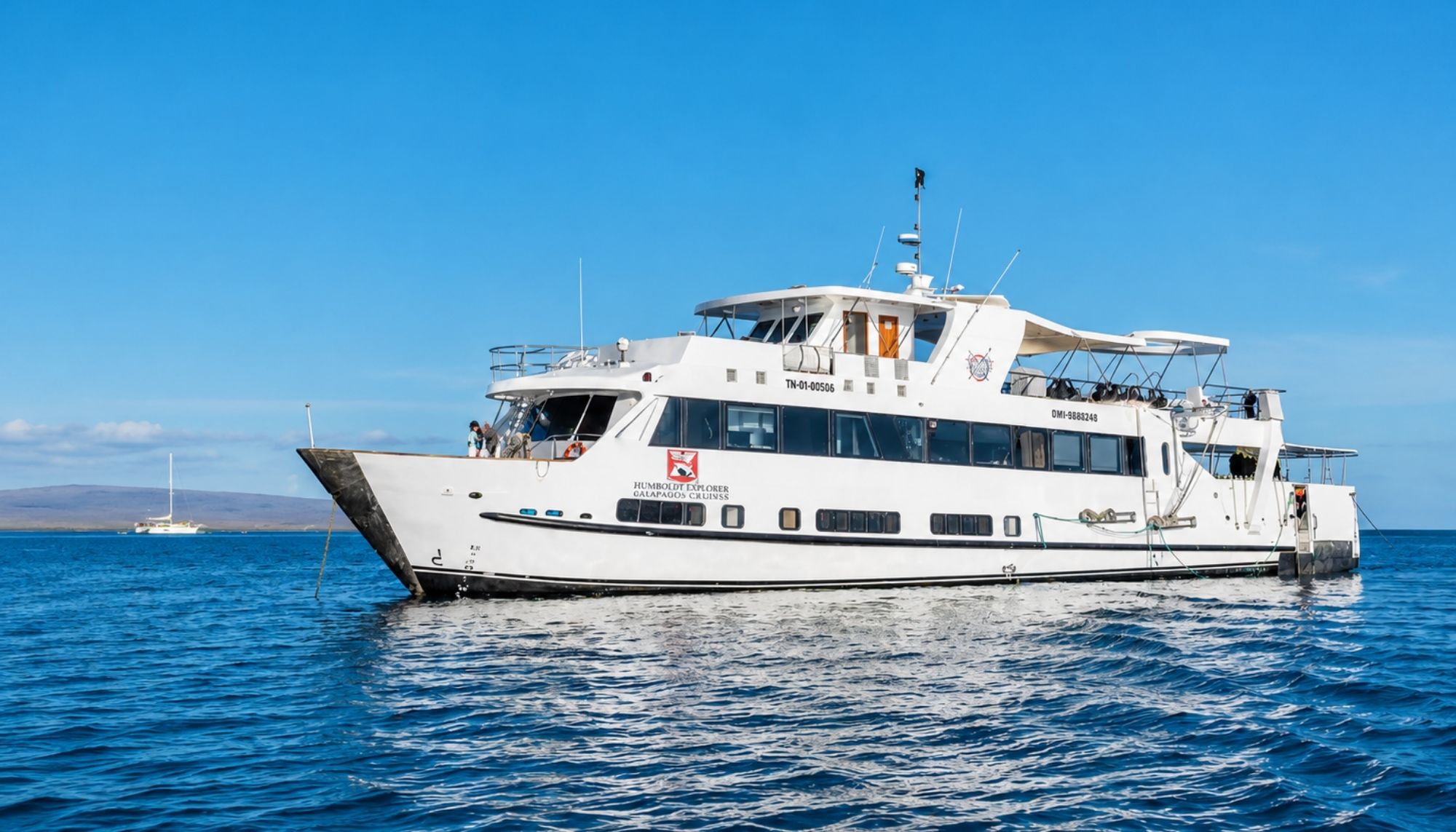
TL;DR
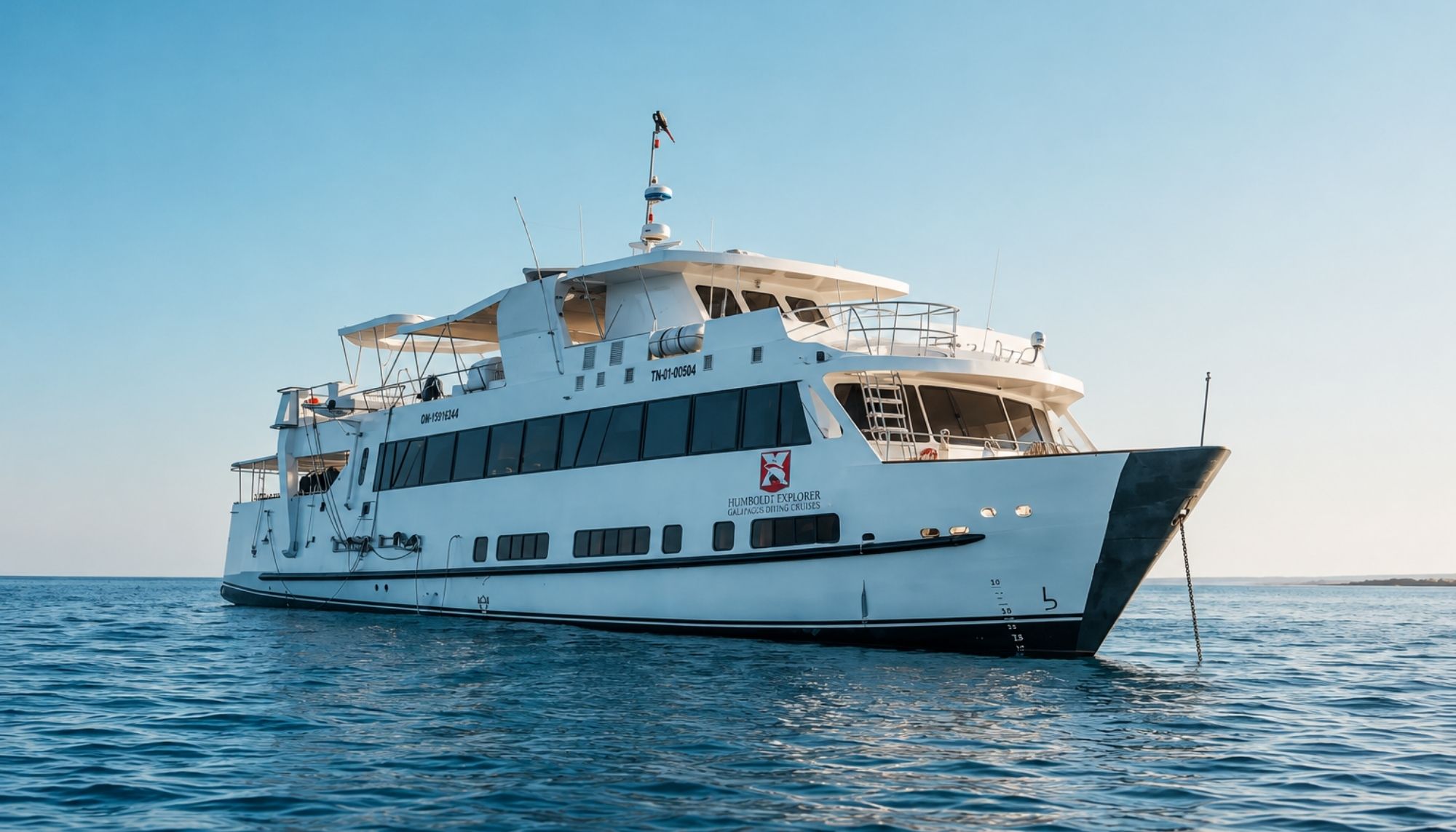
The Humboldt Explorer is a 111-foot dedicated dive liveaboard operated by Explorer Ventures, carrying 16 divers in 8 cabins on 8-day or 11-day itineraries from $6,395 per person. It is the only Galapagos vessel that spends 4 consecutive days diving Darwin and Wolf Islands, the two northernmost sites in the archipelago and widely considered the best pelagic dive destinations on the planet. Completely renovated in spring 2023. Alcohol, all meals, and filled tanks are included. Extra fees add up: budget for a fuel surcharge ($150 to $220), hyperbaric chamber fee ($35), nitrox ($150 to $220 if certified), and the National Park fee ($200). Liveaboard.com aggregate score: 8.8 out of 10 across 90 verified reviews. This is not a snorkeling cruise. It is a diving expedition.
Humboldt Explorer: Quick Facts
| Detail | Info |
|---|---|
| Vessel type | Dedicated dive liveaboard (motor yacht) |
| Class | First Class / Dive Specialist |
| Dimensions | 111.5 ft (34 m) length / 21 ft (6.5 m) beam |
| Capacity | 16 divers |
| Cabins | 8 cabins: 6 on lower deck, 2 on main deck. All convertible between queen and twin. Private en-suite bathrooms, A/C, flat-screen TV, ocean views. |
| Built / renovated | 2009 / fully renovated spring 2023 |
| Operator | Explorer Ventures (international dive liveaboard operator) |
| Crew | 7 crew + 1 naturalist dive instructor + 1 dive instructor assistant |
| Itinerary lengths | 8 days / 7 nights; 11 days / 10 nights |
| Departures | Every Monday from Baltra |
| Price range (2026) | From $6,395 pp (8 days, July 2026 onward). Includes all meals, snacks, alcoholic beverages (national brands), soft drinks, water, coffee, tea, filled tanks, weights, weight belts, transfers. Prices verified September 20, 2026. |
| Required extras (not in base price) | Fuel surcharge $150 to $220 pp; hyperbaric chamber fee $35 pp; National Park fee $200 pp; Transit Control Card $20 pp; nitrox $150 to $220 pp (if certified) |
| Optional extras | Rental gear, nitrox course ($170), land excursions, gratuities, travel insurance |
| Dive infrastructure | Spacious dive deck with 2 camera tables, charging station, individual gear storage, air and nitrox filling stations, tank racks, freshwater camera rinse tank, two large tenders |
| Liveaboard.com score | 8.8 / 10 (90 verified reviews): Crew 8.9, Food 9.4, Diving 9.1, Vessel 8.5, Value 8.0 |
What Is the Humboldt Explorer and Who Is This Cruise Actually Built For?
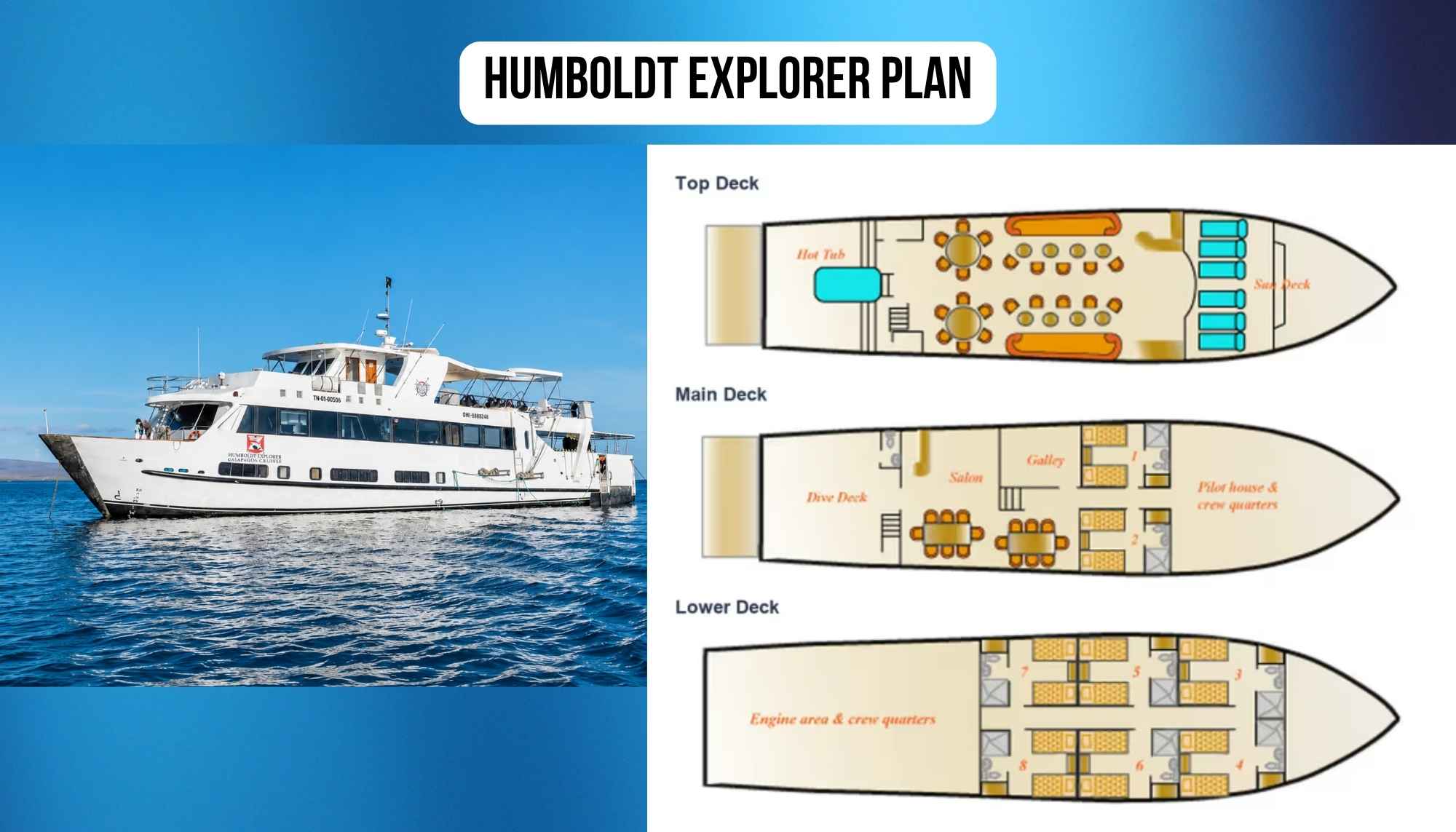
The Humboldt Explorer is a 111-foot dedicated dive liveaboard operated by Explorer Ventures, carrying 16 divers on 8-day or 11-day itineraries departing Baltra every Monday. It is the only vessel in the Galapagos that spends 4 consecutive days diving Darwin and Wolf Islands, the two remote northern sites where whale sharks, hammerhead schools, and massive pelagic aggregations occur at a scale found nowhere else on the planet. Completely renovated in 2023. Base price from $6,395 per person for 8 days before surcharges and fees.
The distinction between this vessel and every other Galapagos cruise in this article series needs to be stated clearly upfront: the Humboldt Explorer is not a wildlife cruise with diving available as an add-on. It is a dive expedition. Non-divers can sail aboard (snorkeling and land excursions are offered), but the vessel’s entire design, scheduling, routing, and crew structure is built around divers. Four days at Darwin and Wolf Islands, the sites no Galapagos surface cruise reaches because they have no permitted land access and sit over 100 kilometers north of the main island chain. The only way to dive them is from a liveaboard, and the only liveaboard that offers 4 full consecutive days there is the Humboldt Explorer.
Darwin Island is widely cited as one of the top five dive sites on Earth. The designation is not hype. The seamount structure at Darwin Arch concentrates pelagic life in a way that produces encounters at a scale that doesn’t exist in most of the ocean. Whale sharks up to 15 meters long, pregnant females who circle the arch in their dozens during peak season. Schooling hammerheads in hundreds. Dolphins and Galapagos sharks and eagle rays sharing the same column of water at the same time. A German diver’s Liveaboard.com review describes waking each morning knowing another session at Darwin was ahead as its own specific pleasure.
This cruise suits: certified divers with at least intermediate experience (the currents at Darwin and Wolf require comfort with drift diving and strong flow), diver couples and groups who want to prioritize marine encounters over island walking, and serious underwater photographers who need the dedicated camera facilities aboard. It does not suit non-divers as a primary experience, first-time snorkelers expecting resort conditions, or travelers whose main Galapagos priority is giant tortoises and blue-footed boobies on land.
If you’re weighing the Humboldt Explorer against a non-diving Galapagos cruise and trying to figure out which type of trip matches what you’re actually after, reach out here and we’ll help you sort it out honestly.
What Are the Cabins and Onboard Spaces Like on the Humboldt Explorer?
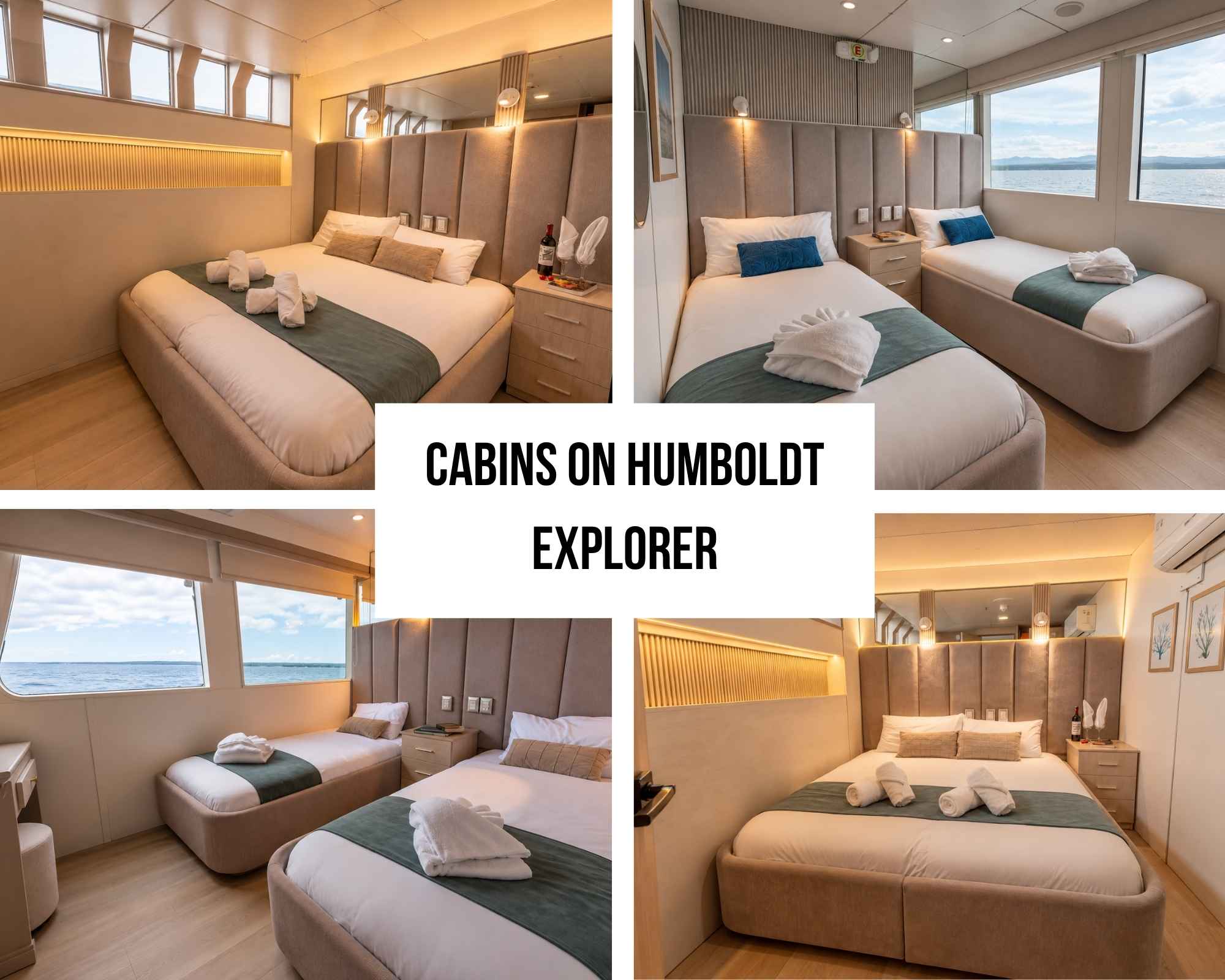
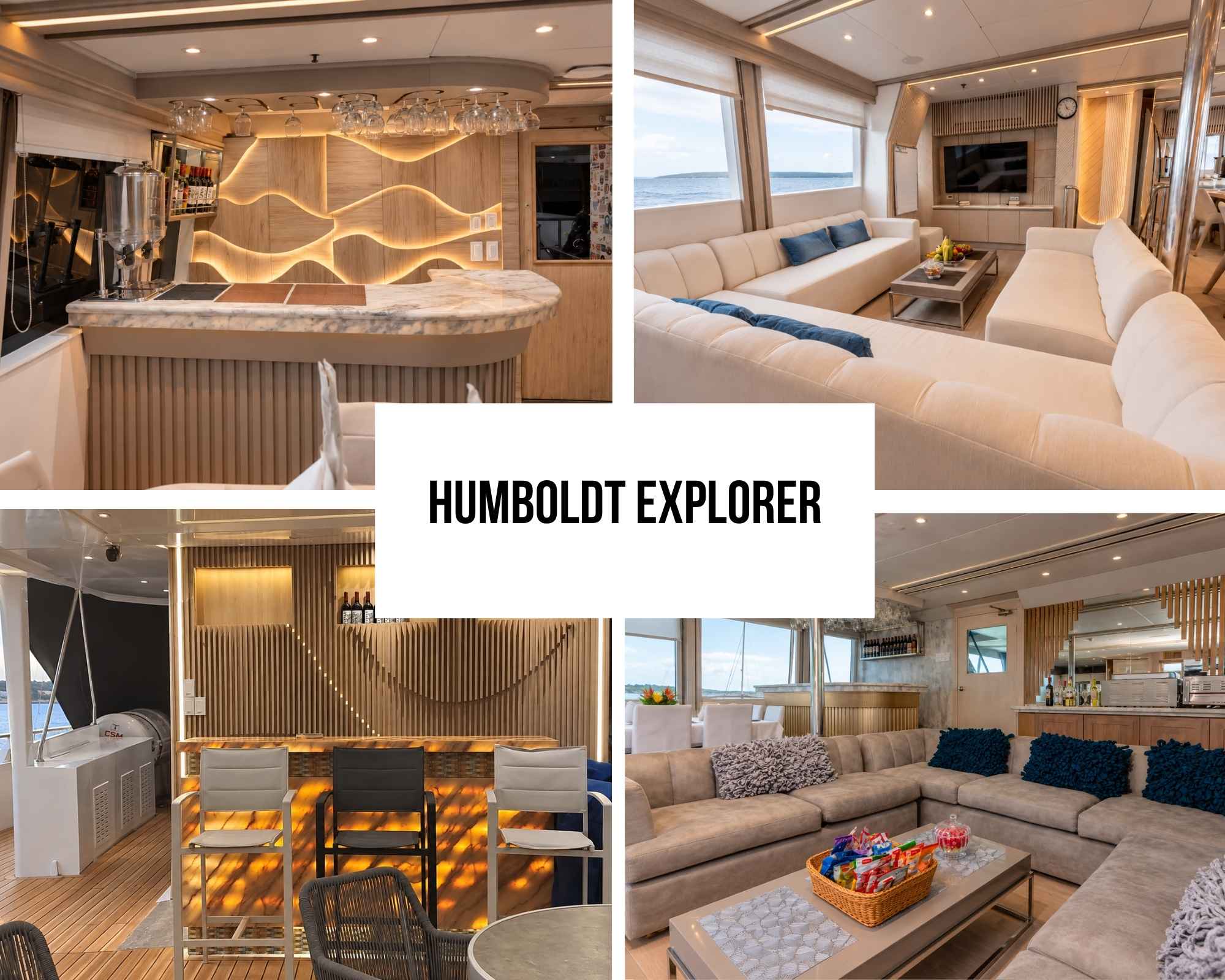
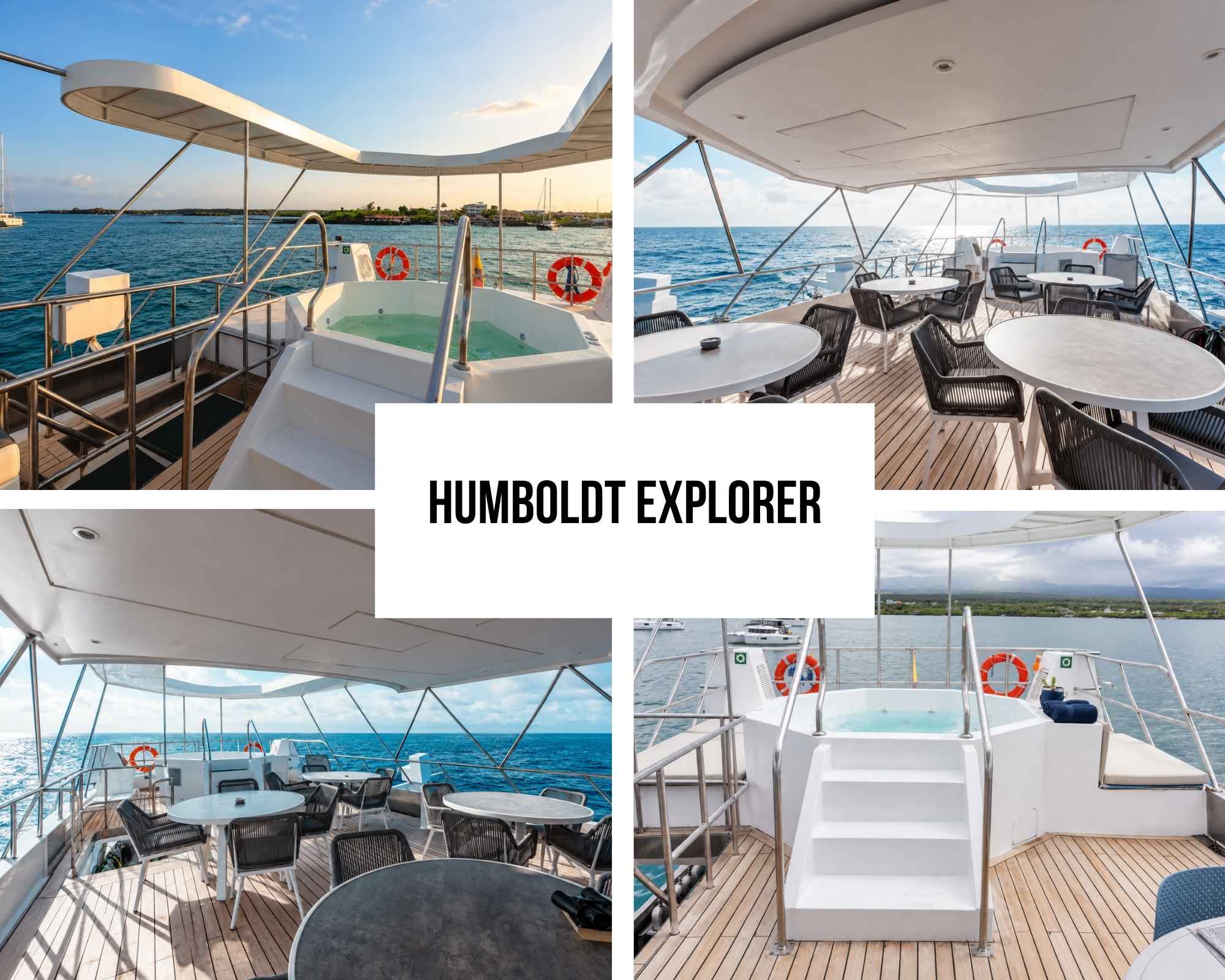
Eight cabins split across two decks: 6 on the lower deck and 2 on the main deck. All convert between twin and queen configurations on request. Every cabin has a private en-suite bathroom with hot water shower, individual A/C control, flat-screen TV, and ocean views through windows. The main deck salon serves as the social hub, with a lounge area, dining tables, entertainment system, and bar. The sun deck above holds a jacuzzi, al fresco bar, and sun loungers. The dive deck at the stern is the operational center of the boat.
The cabin split matters for one practical reason: main deck cabins (only 2 of the 8) are slightly more desirable for the same reason upper-deck cabins usually are on any liveaboard. They’re above the engine room, which means less mechanical noise, and closer to the social spaces. One documented reviewer note specifically flags a fuel smell in forward lower-deck cabins in earlier years. The 2023 renovation addressed this, but if you’re sensitive to vessel smells, a main-deck cabin is worth requesting when booking.
The A/C runs strong. Several independent reviewers describe the salon as genuinely cold between dives, with one noting she was cold for most of the week and ultimately forgave the vessel for it. This is a well-known liveaboard trade-off in warm-water destinations: dive gear dries faster and the post-dive chill is easier to manage in a cool salon than a warm one. Pack a light layer for indoor time regardless of the external temperature, which in Galapagos runs 22 to 28 degrees Celsius depending on season.
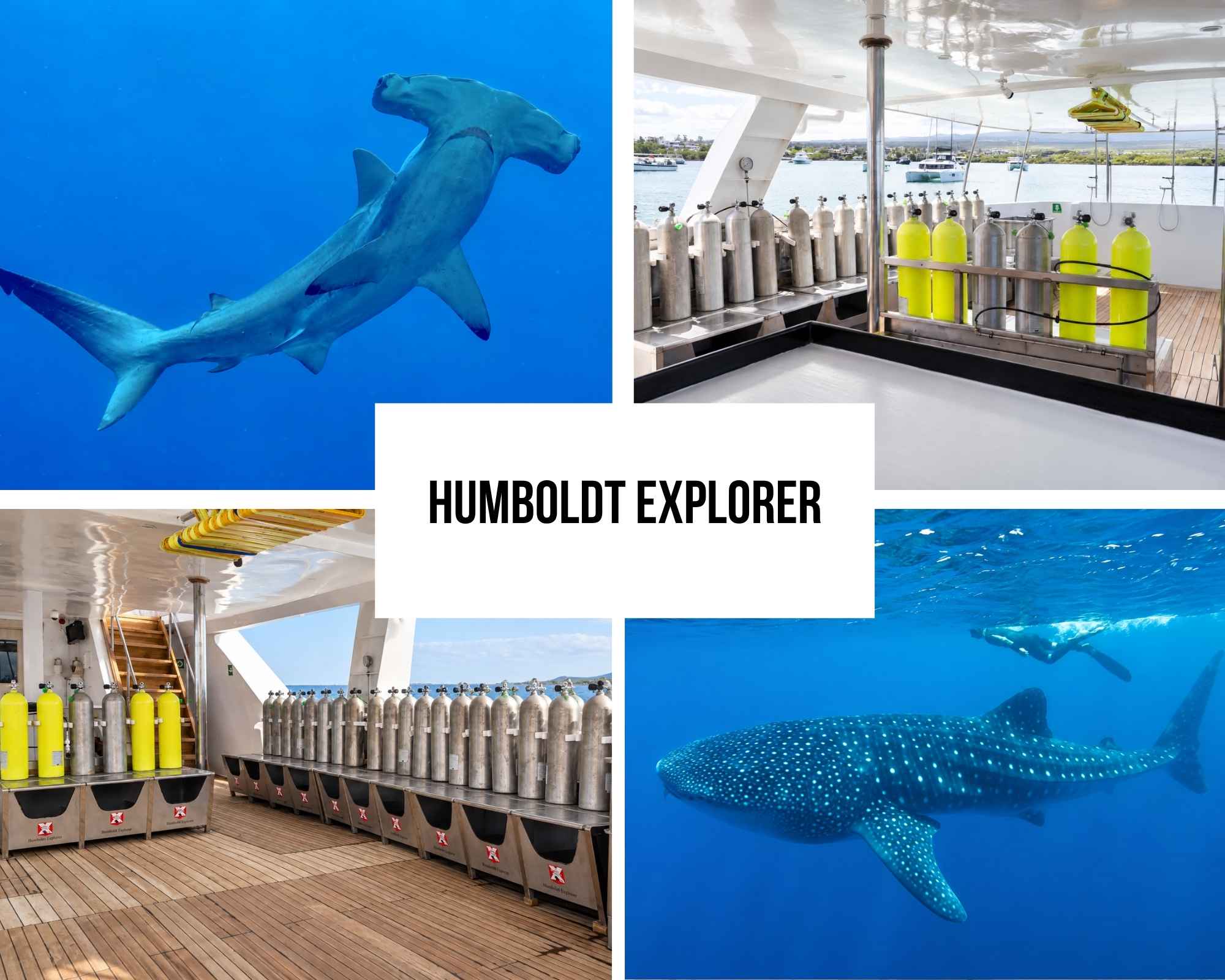
The dive deck is where the Humboldt Explorer’s design investment is most visible. Two dedicated camera tables with charging stations. A separate freshwater rinse tank for camera equipment, kept separate from the general gear rinse bins. Individual gear storage for each diver. Air and nitrox filling stations. Two large tenders that carry divers from the mother ship to the entry points at Darwin and Wolf. Underwater photographers specifically note the camera facilities as one of the vessel’s strongest features.
Which Itineraries Does the Humboldt Explorer Sail and What Will You See?
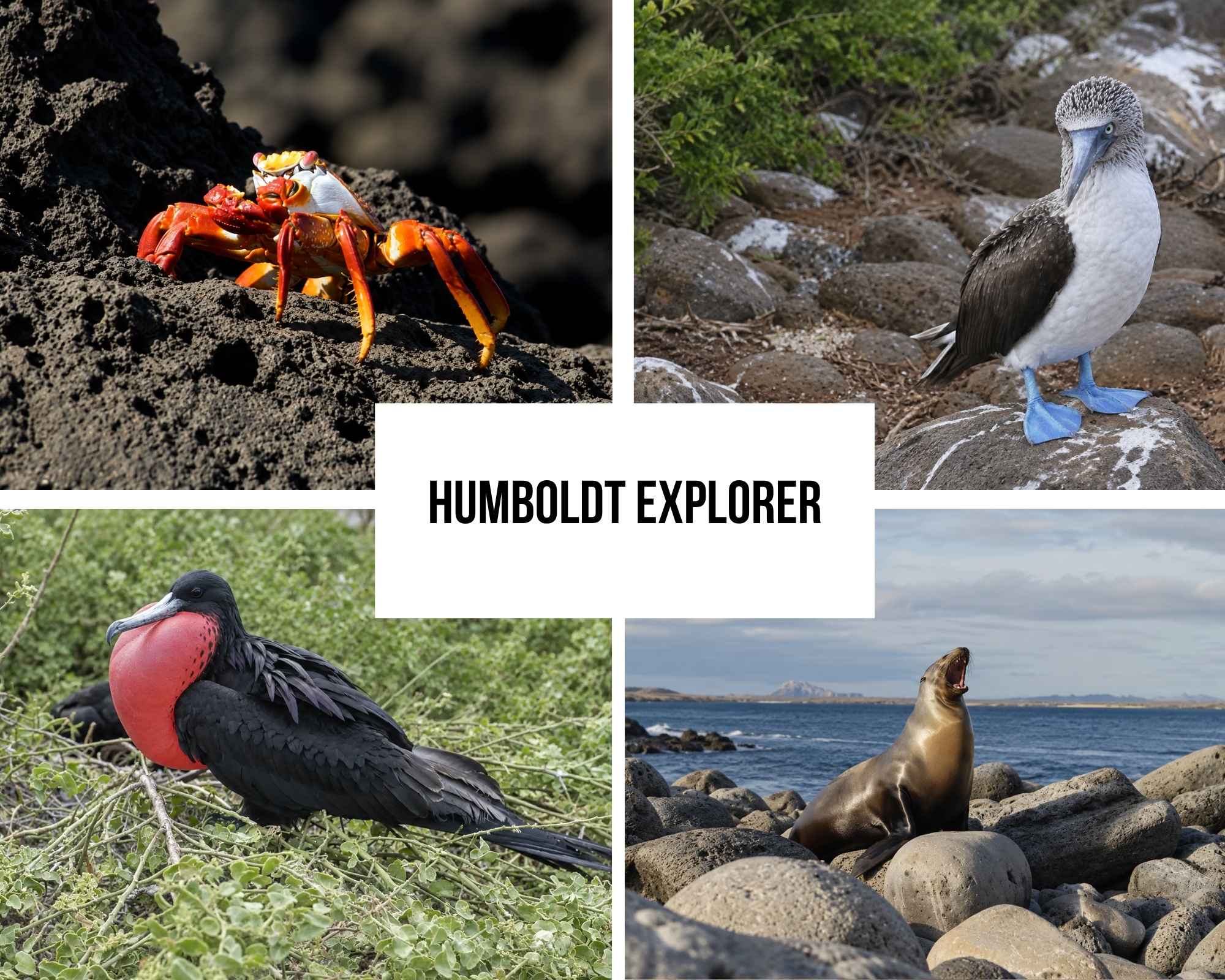
Two itinerary options, both anchored around Darwin and Wolf. The 8-day itinerary departs Baltra every Monday and spends 4 days at Darwin and Wolf before returning via Cousins Rock and a Santa Cruz land visit. The 11-day extends further, adding additional central island dive sites. High season runs July to November when conditions are colder, currents stronger, visibility lower, but whale shark probability peaks. Low season (December to June) brings warmer water, calmer currents, and clearer visibility with fewer whale shark guarantees.
| Itinerary | Length | Key Dive Sites | Wildlife Highlights | Best Season | 2026 Price From (pp) |
|---|---|---|---|---|---|
| 8-Day Galapagos Dive | 8 days / 7 nights | Baltra North (equipment check dives), Wolf Island (Shark Bay, The Landslide, La Banana), Darwin Island (Darwin Arch), Cousins Rock, Santa Cruz (land visit) | Schooling hammerheads, whale sharks (Jul to Nov peak), Galapagos sharks, silky sharks, eagle rays, manta rays, sea lions, dolphins, fur seals, marine iguanas, giant tortoises (land) | Year-round; whale sharks peak Jul to Nov | $6,395 |
| 11-Day Extended | 11 days / 10 nights | All 8-day sites plus additional central Galapagos dive sites including Bartolome, Gordon Rocks, and others | All 8-day species plus Galapagos penguins, marine iguanas, more reef diversity at central sites | Year-round | $8,995 |
Darwin Island deserves its own paragraph because no listing of dive sites fully captures what it produces. The island itself is a basalt pinnacle with no beach and no permitted landing. The dive happens around Darwin Arch, a natural rock formation that breaks the surface and drops into the blue. Currents push nutrient-rich water upwelling from depth, which concentrates baitfish, which concentrates everything that eats baitfish. During peak whale shark season, a single dive at the Arch can produce encounters with multiple whale sharks simultaneously. One reviewer’s group logged 21 whale shark sightings across their week. Another’s encountered a mix of dolphins and hammerheads in a single open-water column.
Wolf Island, a day’s crossing from Darwin, is the warm-up and follow-through. Some of the planet’s highest shark densities. Red-footed booby colonies above water. Coral diversity that produces a completely different underwater texture from the pelagic experience at the Arch. The Humboldt Explorer’s 4-day commitment to these two sites, with 3 to 4 dives per day, produces 12 to 16 individual dives at Darwin and Wolf during an 8-day trip. No other Galapagos operator offers anything approaching that volume at those sites.
The Santa Cruz land visit on day 7 is the one wildlife excursion for non-divers and off-day divers. Giant tortoises at a breeding center, highlands terrain, the Darwin Research Station. One reviewer describes it as “kind of meh” compared to the diving. Fair. It is a land day at the end of a diving week, and it is not the reason anyone books this vessel.
Thinking about the timing for whale sharks vs. visibility and trying to pick a departure month? Send us a quick message and we’ll map the seasonal windows to what you most want to see underwater.
How Is the Food, Crew, and Day-to-Day Experience?

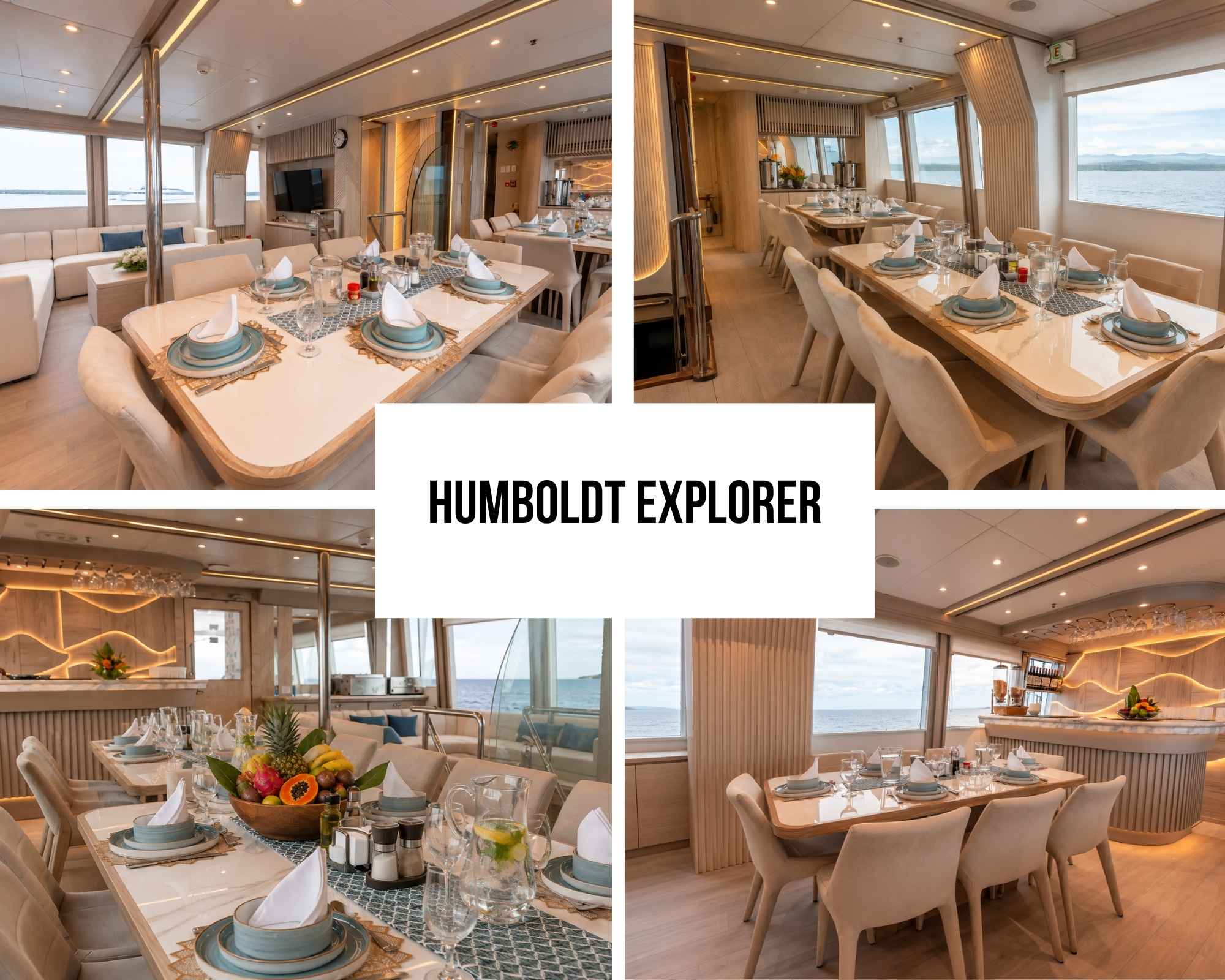
Food scores 9.4 out of 10 across 90 Liveaboard.com reviews, the highest category score on the vessel and higher than many luxury wildlife cruises. Three hearty meals per day plus snacks between dives: breakfast runs to eggs, bacon, pancakes, and fresh fruit; lunch and dinner rotate through chicken, beef, pork, fish, and vegetables with rice. Alcohol (national brands) is included in the base rate. The crew scores 8.9 out of 10 and appears in independent reviews as a consistent highlight, with specific guides named positively across different year cohorts.
The food score of 9.4 is not what most people expect from a dive liveaboard. The catering logic on most dive boats is utilitarian: fuel the divers between dives, keep them from getting too hungry, and don’t complicate logistics. The Humboldt Explorer’s kitchen produces food that independent reviewers describe with genuine enthusiasm. One reviewer notes the crew sourced fresh-caught tuna directly and served it that evening. Another describes the abundance of fresh fruits and vegetables as a specific pleasure. The chef accommodates allergies without the drama that affects some smaller boat operations.
The dive rhythm dictates the day’s schedule more than anything else. Wake early, breakfast before the morning briefing, two dives in the morning, surface interval with snacks and decompression time, lunch, an afternoon dive, rest and dinner, briefing for tomorrow’s sites. The brevity of the surface intervals is a feature rather than a design gap: the sites at Darwin and Wolf are better with fresh eyes and good air than with extended exploration of a ship that has arrived specifically to dive.
Oskar appears by name in multiple independent reviews across different departure years as the dive guide who combines exceptional professional knowledge with personal warmth. A guide named specifically by multiple travelers from different departures is a reliable signal of genuine quality rather than lucky timing. Confirming Oskar’s assignment to your specific departure is worth asking about when booking. Explorer Ventures’ guide retention appears strong based on the review pattern.
How Good Are the Naturalist Guides on the Humboldt Explorer?
One naturalist dive instructor and one dive instructor assistant for 16 divers, producing an 8:1 average ratio in the water. The naturalist role on the Humboldt Explorer combines wildlife knowledge with dive mastery: guides who understand the behavioral ecology of hammerheads and whale sharks are more useful at Darwin than guides who understand terrestrial iguana taxonomy. One Italian reviewer notes “too many divers for each dive guide” in a mixed feedback entry, the only pattern suggesting the ratio is felt at peak capacity. The overall diving score of 9.1 from 90 reviews suggests this is a minority experience rather than a structural problem.
The guide profile on a dedicated dive liveaboard differs from the naturalist guide profile on a wildlife cruise. At Darwin and Wolf, the guide’s primary skills are current reading, safety management in strong drift conditions, and the ability to position the group where encounter probability is highest without spooking the animals. A guide who understands that whale sharks move through a thermocline and positions the group 10 meters deeper to intercept the crossing produces a whale shark encounter. A guide who waits at the standard depth produces an empty blue.
Safety management at Darwin and Wolf is also more demanding than at the central island dive sites. The currents here are significant, the blue water disorients less experienced divers, and the depth means decompression discipline matters. Every review that mentions safety specifically rates it as well-handled. The pre-dive briefings, the 1-2-1 buddy management in the water, and the post-dive debrief structure are all documented as thorough rather than perfunctory.
How Does the Humboldt Explorer Compare to Similar Vessels?
In the Galapagos dedicated dive liveaboard category, the Humboldt Explorer’s main competitors are the Galapagos Sky, the Galaxy Diver II, and the Aggressor III. Against all three, the Humboldt Explorer’s structural advantage is its 4-day Darwin and Wolf commitment. The Galapagos Sky and Aggressor III visit Darwin and Wolf but typically spend fewer consecutive days there. The Galaxy Diver II is the closest direct competitor in terms of site coverage. Price-wise, all four sit in a similar range.
| Vessel | Guests | Days at Darwin/Wolf | Renovated | Liveaboard Score | Key Edge | Trade-off vs. Humboldt |
|---|---|---|---|---|---|---|
| Humboldt Explorer | 16 | 4 (unique) | 2023 | 8.8 / 10 | Only vessel with 4 full days at Darwin and Wolf; 9.4 food score; alcohol included; 2023 refit | Extra fees add up; dive guide ratio felt at full capacity by some; 10-knot speed |
| Galapagos Sky | 16 | 2 to 3 | 2018 | 8.6 / 10 | Strong review history; well-established operator; competitive price | Fewer days at Darwin/Wolf; slightly older refit |
| Galaxy Diver II | 16 | 2 to 3 | 2019 | 8.7 / 10 | Newer build; strong diver reviews; catamaran stability | Fewer days at Darwin/Wolf; catamaran hull limits salon space |
| Aggressor III | 16 | 2 to 3 | 2015 | 8.5 / 10 | Strong global Aggressor brand; established quality standard | Fewer days at Darwin/Wolf; older refit; higher base price |
The 4-day Darwin and Wolf commitment is the decisive comparison point. If you are booking a Galapagos dive liveaboard to maximize time at the planet’s best pelagic sites, the Humboldt Explorer delivers 4 days where its competitors deliver 2 or 3. That extra day at the Arch is another 3 to 4 dives in the best dive environment on the planet. For serious divers, the choice on that dimension alone is not close.
The trade-offs are real. At full capacity, 16 divers sharing 2 tenders and 2 guides means 8 people per guide underwater. One reviewer specifically notes this felt crowded on their trip. The 2023 renovation improved the vessel substantially but it remains a 2009 build, and the extra fees (fuel surcharge, chamber fee, nitrox) add $365 to $455 per person on top of the base rate before park fees. Know the full cost before booking.
What Do Real Travelers Say About the Humboldt Explorer?
Ninety verified reviews on Liveaboard.com averaging 8.8 out of 10 across all categories. Food at 9.4 is the highest individual score, crew at 8.9 is the second highest, diving at 9.1 is strong. Value at 8.0 is the lowest score and reflects the extra-fee structure rather than dissatisfaction with the experience itself. Whale shark sighting accounts run consistently positive in high-season reviews. The single documented pattern complaint across multiple reviews: the A/C in the salon runs intensely cold.
The review corpus is unusual for a Galapagos vessel in that it comes almost entirely from Liveaboard.com rather than TripAdvisor, which reflects the booking channel for dedicated dive trips. Liveaboard.com reviewers are certified divers with previous liveaboard experience, which means the scores are calibrated against a demanding baseline, not a general travel audience. An 8.8 from experienced divers who have also dived the Red Sea, the Coral Triangle, and Palau is a different measurement than an 8.8 from first-time boat travelers.
A reviewer from New Zealand who describes her trip as “one of the best liveaboards in one of the best diving spots in the world” also notes the crew sourced fresh-caught tuna mid-trip and served it that night. That kind of operational detail, a crew that goes beyond the scheduled meal plan when the opportunity arises, appears in multiple accounts and is the clearest signal of a crew that takes genuine pride in the experience they deliver.
The value score of 8.0 is worth addressing honestly. The base price of $6,395 looks competitive against other luxury Galapagos options. By the time you add the fuel surcharge, chamber fee, nitrox, and park fees, the actual all-in cost per person is closer to $7,000 to $7,200 for 8 days. That is still reasonable for the Darwin and Wolf access. But travelers who book the headline price and discover the extras on arrival tend to leave more critical value ratings. The extra fees are fully documented in the booking materials. Read them before booking.
Is the Humboldt Explorer Worth Booking? Our Honest Verdict
Yes, for certified divers who want the best underwater Galapagos experience available. The 4-day Darwin and Wolf commitment is the only reason to choose the Humboldt Explorer over its competitors, and it is a strong enough reason to make the choice straightforward for serious divers. The 2023 renovation, the 9.4 food score, the included alcohol, the dedicated camera facilities, and the guide track record all support the decision. The honest conditions: budget the full all-in cost including surcharges, request a main-deck cabin if fuel smell is a concern, bring a layer for the A/C salon, and be nitrox certified if you want access to all dives.
The whale shark question is the most common one we get from travelers considering this vessel. Can you guarantee a sighting? No. No operator can. What the data across 90 reviews shows is that high-season departures between July and November produce whale shark encounters at a high rate. One group logged 21 sightings in a week. A 10/10 reviewer from the UK describes “a massive slow and long whale shark encounter” at Darwin. These are not extraordinary stories. They are consistent with what the current dynamics at Darwin Arch produce when the season and conditions align.
Non-divers can sail the Humboldt Explorer but should do so only if they are genuinely happy spending most of a week on a vessel optimized for divers, with limited snorkeling options at Darwin and Wolf compared to the central island sites. If the primary goal is above-water wildlife (giant tortoises, blue-footed boobies, albatross), a wildlife cruise is the right choice and the Humboldt Explorer is not.
Ready to check availability and compare the Humboldt Explorer against other Galapagos dive liveaboards for your target dates? Get in touch here for a free quote and an honest comparison. No booking commitment required.
What Travelers Actually Report: Humboldt Explorer Cohort Feedback
Based on feedback gathered through mytrip2ecuador.com, our YouTube audience, and traveler conversations Oleg has conducted, combined with the 90-review Liveaboard.com dataset. The Humboldt Explorer has one of the more robust independent review records among Galapagos dive vessels, with reviews spanning multiple years both before and after the 2023 renovation.
| Food quality | 94% | 5% | 1% | Highest-rated category (9.4/10 on Liveaboard.com); fresh-caught fish, fruit abundance, and dietary accommodation all specifically praised; American and Ecuadorian hybrid menu consistently positive |
| Crew and service | 91% | 7% | 2% | Crew cohesion and warmth appear in most accounts; guide Oskar named positively across multiple departure years; dive logistics praised for efficiency and safety focus |
| Diving quality | 90% | 8% | 2% | Darwin and Wolf accounts dominate; whale shark, hammerhead, and pelagic diversity consistently rated exceptional; one review notes “too many divers per guide” at peak capacity |
| Cabin comfort | 82% | 13% | 5% | Post-2023 renovation quality noted positively; salon A/C rated too cold by several reviewers; main-deck cabins preferred over lower-deck for noise; fuel smell in forward lower cabins (pre-2023 refit concern, may be resolved) |
| Value for money | 74% | 19% | 7% | Base price competitive; extra fees (fuel $150 to $220, chamber $35, nitrox $150 to $220, park $200) reduce perceived value when not budgeted for in advance; all-in cost closer to $7,000 to $7,200 pp for 8 days |
| Wildlife encounters | 96% | 3% | 1% | Darwin and Wolf consistently deliver; whale sharks in high season appear in most accounts; hammerhead schools year-round; one group logged 21 whale shark sightings in a week |
What to Know Before You Book the Humboldt Explorer
The extra fees are required, not optional, and they add up significantly. The fuel surcharge ($150 to $220 per person), hyperbaric chamber fee ($35), and Galapagos National Park fee ($200) are all mandatory. Nitrox ($150 to $220) is optional but recommended for anyone certified, as some deeper Darwin and Wolf dives benefit from extended bottom time on enriched air. The Transit Control Card ($20) must be purchased through the official digital platform before flying to the Galapagos, as of September 2026. Budget the real all-in cost: roughly $7,000 to $7,200 per person for 8 days.
Nitrox certification opens more of the dive program. Some dives at Darwin and Wolf reach depths where nitrox certification allows extended no-decompression limits that air divers don’t have. Non-nitrox divers can still participate but may surface earlier on deeper dives. If you are planning this trip, completing an nitrox course before departure is worth the two-day investment.
The currents at Darwin and Wolf are serious. This is not a casual diving destination. You need to be comfortable managing yourself in strong drift currents, comfortable in open blue water without a reef wall to orient against, and capable of buddy management under less-than-ideal visibility. The operator lists no minimum certification above Open Water, but every experienced diver who has reviewed the vessel independently recommends prior drift diving experience. The dive guides manage safety well, but you will be more comfortable and have better encounters if you arrive prepared.
The A/C in the salon runs cold. Bring a light fleece or layer for indoor time. The external temperature in the Galapagos ranges from 22 to 28 degrees Celsius depending on season, which means the temperature contrast between deck and salon is noticeable. This is a minor complaint in 90 reviews but consistent enough to warrant a mention and an easy fix.
The land excursion on the final day is limited. The Santa Cruz tortoise visit on day 7 is the only significant above-water wildlife excursion in the 8-day itinerary. It is a worthwhile hour, but it is a small addendum to a dive-focused week, not a balanced land-sea experience. Travelers who want meaningful above-water wildlife encounters across multiple days should book a dedicated wildlife cruise instead.
Frequently Asked Questions
Is the Humboldt Explorer only for divers?
It is designed for divers. Non-divers can sail aboard and participate in snorkeling sessions and the land excursion, but the vessel’s routing, scheduling, and facilities are built around diving. Non-divers who sail primarily for the Galapagos wildlife above water would be better served by a dedicated wildlife cruise.
What is the best season for whale sharks on the Humboldt Explorer?
July to November is peak whale shark season at Darwin and Wolf Islands. Conditions during this period are colder, currents are stronger, and visibility is lower, but encounter probability is highest. December to June brings warmer water, calmer conditions, and better visibility, with fewer whale shark guarantees but strong hammerhead and pelagic activity year-round.
Are the Galapagos park fees included in the price?
No. The $200 USD adult Galapagos National Park fee and $20 USD Transit Control Card are required extras, not included in the base fare. The TCT must be purchased through the official digital platform before flying to the islands. Prices verified September 20, 2026.
Do I need nitrox certification for the Humboldt Explorer?
It is not required, but strongly recommended. Some dives at Darwin and Wolf reach depths where nitrox certification extends the available bottom time beyond what air allows. Non-certified divers can participate but may surface earlier on deeper dives. A nitrox course before departure costs approximately $170 on board if needed.
Considering the Humboldt Explorer?
We can compare it against every other Galapagos dive liveaboard and help you match the right vessel to your dive experience level, target species, and travel dates. Cruises To Galapagos Islands holds a 4.9-star rating on both Google and TripAdvisor.
Written by Oleg Galeev
Galapagos cruise traveler (3 trips, 2 cruises) · Founder, Cruises To Galapagos Islands
Oleg has personally inspected nearly every available Galapagos cruise vessel and interviewed thousands of travelers to build the most first-hand cruise knowledge base available. He also runs the Ecuador travel blog mytrip2ecuador.com and the YouTube channel My Trip to Somewhere.
Cruises To Galapagos Islands is rated 4.9 stars on Google and TripAdvisor.
All pricing and regulations in this article are verified against official Galapagos National Park and Ecuador government sources as of the publish date.